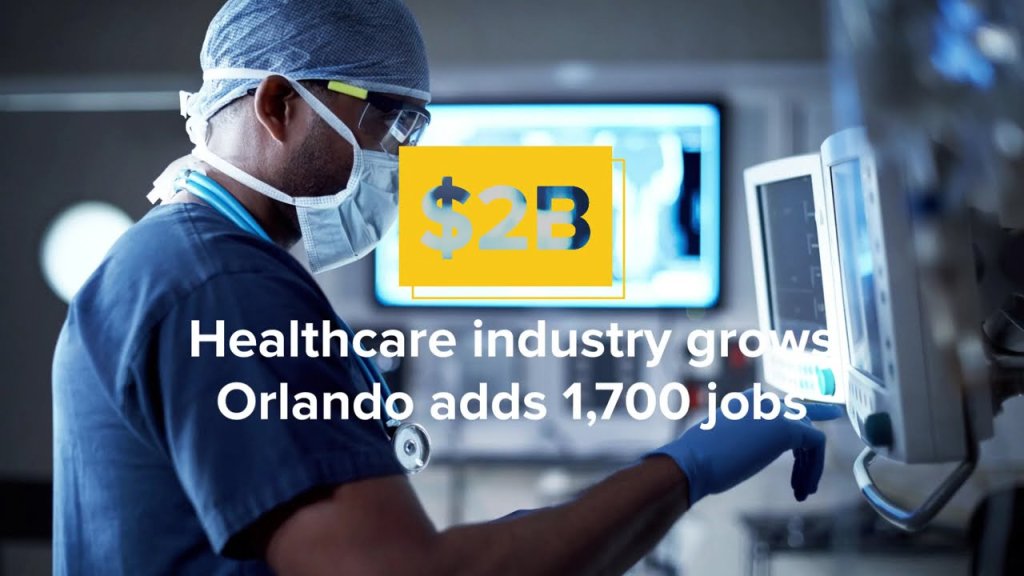
Orlando is still known for tourism, but healthcare is becoming one of Central Florida’s most important job engines. New 2026 labor data shows the Orlando-Kissimmee-Sanford metro area had 209,300 jobs in education and health services as of April 2026, according to preliminary data from the U.S. Bureau of Labor Statistics.
That equals about 13.8% of all nonfarm jobs in the metro area, based on total nonfarm employment of 1,517,900 jobs. The sector added about 7,400 jobs year over year and grew 3.7%, compared with 1.1% growth for Orlando’s total nonfarm job market.
The headline is simple. Healthcare is not just a support industry in Orlando. It is one of the region’s most stable large employment sectors, and it is growing faster than the overall local job market while several other industries are flat or down.
Orlando’s healthcare economy is also broader than hospital employment. The regional ecosystem includes specialty pharmacies, medical device companies, clinical research organizations, behavioral health providers, home medical equipment companies, university medical programs, and healthcare technology firms. Orlando Economic Partnership reports 265,000+ workers in life sciences and healthcare across the seven-county Central Florida region, using Lightcast QCEW data from Q1 2026.
Two major health systems anchor the market. AdventHealth and Orlando Health are both headquartered in the Orlando region and remain two of the largest healthcare employers in Central Florida. Updated employer data from Orlando Economic Partnership lists AdventHealth at 40,000 employees and Orlando Health at 28,806 employees in the Orlando MSA.
Why this matters for Orlando in 2026
The 2026 data shows a shift in how Orlando should be understood. Tourism is still the region’s largest public identity, but healthcare is becoming one of the strongest pieces of its economic base. That matters for workers, employers, site selectors, real estate planners, colleges, and local service businesses.
- Healthcare is growing faster than the overall job market. Education and health services grew 3.7% year over year, compared with 1.1% for all nonfarm jobs.
- The sector has local headquarters strength. AdventHealth and Orlando Health are not only hospital operators. They are major regional employers headquartered in Central Florida.
- The job base is wider than clinical care. Specialty pharmacy, medical devices, clinical research, behavioral health, home medical equipment, and health administration all add employment depth.
- Population growth supports long-term demand. More residents create more need for primary care, pediatrics, urgent care, imaging, specialty care, behavioral health, and senior care.
2026 Orlando healthcare employment
This chart uses the official BLS education and health services category, which combines education and healthcare-related jobs. It is the closest major labor category for tracking healthcare employment trends in the Orlando MSA. Employment rose from 207,600 jobs in November 2025 to 209,300 jobs in April 2026, with a January dip followed by steady gains through spring.
| Month | Education & Health Services Jobs | 12-Month Change |
|---|---|---|
| April 2026 | 209,300 | +3.7% |
| March 2026 | 208,700 | +4.3% |
| February 2026 | 207,300 | +3.8% |
| January 2026 | 206,800 | +4.4% |
| December 2025 | 208,300 | +5.5% |
| November 2025 | 207,600 | +5.1% |
Source: U.S. Bureau of Labor Statistics, Orlando-Kissimmee-Sanford Economy at a Glance. April 2026 figures are preliminary.
How healthcare compares with Orlando’s other major industries
Education and health services is not Orlando’s largest employment sector, but it is one of the most important large job categories for long-term economic strength. Leisure and hospitality remains bigger because tourism is still a major part of the regional economy. Healthcare stands out because it combines scale, steady hiring, local headquarters, specialized jobs, and population-driven demand.
The April 2026 labor data also shows why healthcare matters when other parts of the economy slow down. Construction, trade, transportation and utilities, financial activities, information, and other services were down year over year. Education and health services grew 3.7%, making it one of Orlando’s strongest large sectors by growth rate.
| Industry Sector | April 2026 Jobs | 12-Month Change |
|---|---|---|
| Leisure and Hospitality | 306,500 | +4.1% |
| Professional and Business Services | 279,200 | +1.2% |
| Trade, Transportation, and Utilities | 267,800 | -0.7% |
| Education and Health Services | 209,300 | +3.7% |
| Government | 137,600 | -0.1% |
| Financial Activities | 93,000 | -1.7% |
| Construction | 91,500 | -2.0% |
| Manufacturing | 52,900 | -0.4% |
Source: U.S. Bureau of Labor Statistics, Orlando-Kissimmee-Sanford Economy at a Glance. April 2026 figures are preliminary.
Orlando’s largest healthcare employers
AdventHealth and Orlando Health remain the two clear anchors of Orlando’s healthcare industry. Together, they account for 68,806 local employees in the Orlando MSA based on Orlando Economic Partnership’s updated employer data. That does not include the full economic effect of vendors, contractors, medical education, real estate, research, and nearby service businesses that support these systems.
The rest of the employer list shows how broad the market has become. HCA Healthcare, Nemours Children’s Hospital, Osceola Regional Medical Center, Consulate Health Care, Aspire Health Partners, specialty pharmacy companies, and medical equipment providers all add different types of jobs. This is why Orlando’s healthcare economy should not be described only as a hospital market.
| Company | Location | Subsector | Employment |
|---|---|---|---|
| AdventHealth System | Orlando | Health System / HQ | 40,000 |
| Orlando Health | Orlando | Health System / HQ | 28,806 |
| HCA Healthcare | Orlando | Regional Hospital | 4,831 |
| Walgreens Specialty Pharmacy | Orlando | Specialty Pharmacy | 3,799 |
| Rotech Healthcare, Inc. | Orlando | Home Medical Equipment | 3,500 |
| Nemours Children’s Hospital | Orlando | Children’s Hospital | 3,132 |
| Consulate Health Care LLC | Maitland | Senior Housing and Care | 2,215 |
| Osceola Regional Medical Center | Kissimmee | Major Medical Center | 2,190 |
| Aetna Specialty Pharmacy / CVS | Orlando | Retailer Health Care | 1,308 |
| CuraScript SD | Lake Mary | Specialty Pharmaceutical Distribution | 1,300 |
Source: Orlando Economic Partnership, Life Sciences & Healthcare Leading Employers, updated November 2025.
Orlando healthcare is bigger than hospitals
One of the most useful ways to understand Orlando healthcare in 2026 is to separate the hospital systems from the supporting healthcare and life sciences ecosystem. The region has large hospital networks, but it also has specialty pharmacy, health IT, medical devices, pharmacy management, home medical equipment, clinical research, and behavioral health employers.
This matters for job seekers and companies. A nurse, medical assistant, surgical technologist, pharmacy operations worker, health information specialist, clinical research coordinator, billing specialist, or healthcare marketer may all work in the same broader sector, but their career paths can look very different. Orlando’s advantage is that the market has enough scale to support many of these paths.
| Subsector | Example Employers | Why It Matters |
|---|---|---|
| Hospital Systems | AdventHealth, Orlando Health, HCA Healthcare | Largest source of direct healthcare employment and clinical training |
| Children’s and Specialty Care | Nemours Children’s Hospital, Arnold Palmer Hospital | Supports pediatric, women’s, trauma, and specialty services |
| Specialty Pharmacy | Walgreens Specialty Pharmacy, CuraScript SD, AcariaHealth | Adds pharmacy, patient management, distribution, and operations jobs |
| Medical Devices and Equipment | Rotech Healthcare, Iradimed, LensAR, Ziehm Imaging | Builds a link between healthcare, manufacturing, and technology |
| Behavioral Health | Aspire Health Partners | Supports mental health and substance use treatment needs |
| Clinical Research | Compass Research and hospital research programs | Connects Orlando healthcare to trials, innovation, and new treatments |
Orlando Economic Partnership describes the region’s life sciences industry as anchored by AdventHealth and Orlando Health, with medical research, specialized care, health innovation, and a large patient base supporting continued growth. The Partnership also notes that Florida’s large resident population and Orlando’s visitor volume create a broad patient population for specialized care and patient management.
Population growth is feeding healthcare demand
Healthcare demand in Orlando is tied to more than local job growth. Orlando Economic Partnership notes that Florida’s 23 million residents and Orlando’s 75 million annual visitors create a large and diverse patient population. That demand supports hospitals, urgent care centers, specialty care, pharmacy services, imaging, behavioral health, and patient management across Central Florida.
This creates a practical reason for healthcare hiring to stay strong. More residents mean more primary care demand, more pediatric visits, more chronic disease care, more specialty procedures, more imaging, more urgent care, more behavioral health needs, and more administrative work behind the scenes.
AdventHealth’s Central Florida Division reports more than 3.4 million patient visits annually, 20+ hospitals and ERs, 4,511 beds, 3,400+ staff physicians, and 500+ clinical trials. Orlando Health reports more than $1.3 billion in total community impact through charity care, community benefit programs, services, and community-building activities.
| Healthcare System Metric | Most Recent Public Figure | Source |
|---|---|---|
| AdventHealth Central Florida annual patient visits | 3.4M+ | AdventHealth Central Florida media resources |
| AdventHealth Central Florida hospitals and ERs | 20+ | AdventHealth Central Florida media resources |
| AdventHealth Central Florida beds | 4,511 | AdventHealth Central Florida media resources |
| AdventHealth Central Florida staff physicians | 3,400+ | AdventHealth Central Florida media resources |
| AdventHealth Central Florida clinical trials | 500+ | AdventHealth Central Florida media resources |
| Orlando Health total community impact | $1.3B+ | Orlando Health Community Benefit |
Sources: AdventHealth Central Florida Division media resources and Orlando Health Community Benefit.
Healthcare jobs without a four-year degree
A useful 2026 angle is the healthcare talent pipeline. Many Orlando healthcare jobs offer practical career paths without requiring a bachelor’s degree. This matters because healthcare can help workers move from entry-level roles into higher-paid clinical and technical positions through certificates, associate degrees, and employer-supported training.
Orlando Economic Partnership’s healthcare talent report highlights roles in the Orlando region that meet this pattern. Many require an associate degree or a postsecondary nondegree award rather than a four-year degree. That makes healthcare one of the more practical industries for upward mobility in Central Florida.
| Healthcare Role | Median Wage | Typical Entry-Level Education |
|---|---|---|
| Licensed Practical and Licensed Vocational Nurses | $27.95/hour | Postsecondary nondegree award |
| Radiologic Technologists and Technicians | $31.69/hour | Associate degree |
| Surgical Technologists | $27.45/hour | Postsecondary nondegree award |
| Physical Therapist Assistants | $33.47/hour | Associate degree |
| Respiratory Therapists | $37.30/hour | Associate degree |
| Diagnostic Medical Sonographers | $37.41/hour | Associate degree |
| Magnetic Resonance Imaging Technologists | $37.66/hour | Associate degree |
| Occupational Therapy Assistants | $35.17/hour | Associate degree |
| Nuclear Medicine Technologists | $41.27/hour | Associate degree |
| Radiation Therapists | $42.20/hour | Associate degree |
Source: Orlando Economic Partnership, Healthcare Talent Report 2025, using BLS Occupational Employment Survey data.
This is one reason healthcare has a different economic role than some other sectors. It does not only create high-level physician, executive, and research jobs. It also creates middle-skill clinical and technical roles that can support stable household income without requiring a traditional four-year college path.
Expansion in healthcare and life sciences
Recent expansion data shows that Orlando’s healthcare growth is not limited to hospitals. Specialty pharma, clinical research, healthcare services, medical technology, and patient support companies have continued to expand in the region over the past few years.
Recent expansion announcements from 2022 through 2024 help show the direction of the market. Specialty pharma, clinical research, healthcare services, and patient support companies have all added jobs in the Orlando region. The 2026 employment data shows that this broader healthcare and life sciences ecosystem has continued to grow beyond individual company announcements.
| Company | Type of Operation | Jobs Announced | Announcement Period | Location |
|---|---|---|---|---|
| VillageMD | Healthcare Centers | 411 | October 2022 | Multiple Locations |
| Wesley Pharmaceuticals | Specialty Pharma | 255 | August 2024 | Orlando |
| Raremed | Specialty Pharma | 200 | September 2024 | Orlando |
| FreedomCare | Healthcare Call Center | 142 | February 2022 | Various |
| CMT Solutions | Healthcare Services | 130 | August 2022 | Orlando |
| Charter Research | Clinical Research / Specialty Pharma | 70 | September 2024 | Orlando |
| Applied Ingenuity Diagnostics | Healthcare Center | 20 | June 2022 | Orlando |
Note: These are selected public expansion announcements from prior Orlando Economic Partnership market materials. They are included as examples of healthcare and life sciences growth, not as a complete count of all hiring or investment in the region.
Healthcare economic impact
Healthcare is a stabilizing force in Orlando’s economy. Tourism can move with travel trends, consumer budgets, and seasonal demand. Construction can slow when interest rates or financing conditions change. Healthcare demand is different because it is tied to population, age, chronic disease, insurance coverage, emergency needs, and specialized care.
The April 2026 data supports this point. Total nonfarm employment in Orlando grew 1.1% year over year. Education and health services grew 3.7%. That means the sector grew more than three times faster than the overall job market during the same period.
| Economic Indicator | 2026 Orlando Figure | What It Means |
|---|---|---|
| Total Nonfarm Employment | 1,517,900 jobs | Orlando remains a large regional employment market |
| Education and Health Services Employment | 209,300 jobs | One of the region’s biggest employment sectors |
| Sector Share of Employment | 13.8% | About 1 in 7 nonfarm jobs are in this combined category |
| Education and Health Services YoY Growth | +3.7% | Faster than the overall metro job market |
| Estimated Jobs Added YoY | About 7,400 | A major contributor to regional job growth |
| Total Nonfarm YoY Growth | +1.1% | The broader labor market grew more slowly |
For local workers, this means healthcare can offer more than one type of opportunity. It includes entry-level roles, technical roles, clinical careers, administrative paths, management roles, IT roles, and research-related work. For businesses, it means healthcare employers create demand for real estate, recruiting, training, staffing, legal services, marketing, facility services, software, and local suppliers.
2026 outlook for Orlando healthcare
The 2026 outlook for Orlando healthcare remains positive. Current labor data shows that education and health services reached 209,300 jobs in April 2026 and grew 3.7% year over year. That growth outpaced Orlando’s overall nonfarm job market and supports the view that healthcare remains one of the region’s most reliable long-term industries.
The strongest parts of the outlook are clear.
- Large local anchors. AdventHealth and Orlando Health are both headquartered in the region and employ tens of thousands of people locally.
- Specialty growth. Specialty pharmacy, medical devices, clinical research, and healthcare technology give the market more depth than hospital employment alone.
- Career access. Many healthcare roles do not require a bachelor’s degree and can still offer practical career paths through certificates, associate degrees, and technical training.
- Population-driven demand. Orlando’s growing resident base and visitor volume support demand for urgent care, primary care, specialty care, pediatrics, imaging, and hospital services.
The main caution is wording. Public labor data often combines education and healthcare into one supersector. For accuracy, use “education and health services” when citing BLS employment totals. When discussing hospitals, physicians, clinical trials, employers, or specialty care, use healthcare-specific sources such as AdventHealth, Orlando Health, and Orlando Economic Partnership’s life sciences and healthcare reports.
What the data says
The strongest 2026 takeaway is that Orlando healthcare has moved beyond a simple hospital jobs story. The sector now supports a large job base, major headquarters, specialty care, pharmacy operations, medical equipment, clinical research, education programs, and business services.
For job seekers, that means healthcare offers more routes into stable work than many people expect. For local companies, it means healthcare buyers, employees, vendors, and referral networks are becoming a larger part of the Orlando economy. For city and county planners, it means healthcare should be treated as one of the region’s core growth sectors, not just a public service category.
Orlando healthcare is now a core growth sector
Orlando’s healthcare industry is now one of the strongest employment pillars in Central Florida. The region has more than 209,000 jobs in education and health services, a large healthcare and life sciences workforce across Central Florida, two major health systems headquartered locally, and a growing base of specialty pharmacy, medical device, clinical research, and healthcare service companies.
The most important takeaway is not just that healthcare is big. It is that healthcare is one of Orlando’s most stable and useful growth sectors. It creates jobs across skill levels, supports local families, attracts specialized companies, and gives the regional economy a stronger base beyond tourism alone.
Sources
- U.S. Bureau of Labor Statistics Orlando-Kissimmee-Sanford, FL Economy at a Glance
- Orlando Economic Partnership Life Sciences and Healthcare Leading Employers
- Orlando Economic Partnership Life Sciences and Healthcare Industry Overview
- Orlando Economic Partnership Healthcare Talent Report 2025
- AdventHealth Central Florida Division Media Resources
- Orlando Health Community Benefit